

SIEM deployment
You find out right away, not when someone complains
SIEM deployment across your fleet, in two modes. In both, whatever crosses the criticality threshold agreed with you reaches your phone as soon as the SIEM receives the record. In respond mode, the rule also acts, only on what you approve.

The problem
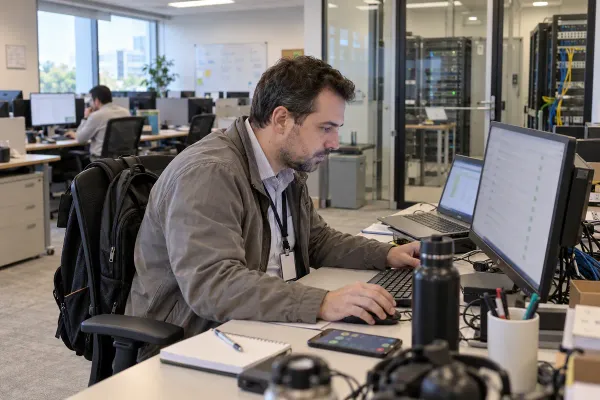
The firewall, the servers and the workstations already record everything, but nobody reads it. When the problem shows up, the user is the one who reports it, days later. In one fleet assessment, detection had been switched off for seventeen months without a single alert.
In action
See it happen
- A day of records
- Firewall attack
- Critical CVE
- The message
In practice
In production at Grupo NTK
SIEM & Alerting runs today at Grupo NTK, alongside the other six solutions. What seven years of modernization changed is in the case.

What you get
What ends up running in your environment
- SIEM deployed from scratch on an open base: no per-volume license, with the data where you choose and kept for as long as an investigation requires
- Agents on the machines and servers, and the firewall logs arriving in the same place
- Rules tuned to your environment, so an alert is the exception and not noise
- A criticality threshold agreed with you: critical goes to your phone, and the rest is recorded and searchable
- A message ready to read on the phone: what happened, where, how severe, and whether the firewall blocked it
- The watchdog: if the SIEM itself stops, that alert arrives too
How it works
From log to phone, step by step
-
We connect the sources
Agents on the machines and servers, and the firewall logs arriving in the same place.
-
We tune the rules
To your environment, so an alert is the exception and not noise.
-
We agree the threshold
Whatever crosses it goes to the phone of whoever you choose; the rest is recorded and searchable.
-
The critical alert arrives
With what happened, where and how severe. In respond mode, the rule also acts, only on what you approved.
Delivery models
Choose how to engage
Detect & Alert
We deploy the SIEM, agree the criticality threshold with you and hand it over working. Critical alerts reach the phone of whoever you choose, and the decision on each one belongs to your team. Support after handover is optional: SIEM updates, agents on new machines, review of rules and noise, and the watchdog.
Detect & Respond
Everything in alert mode, and the rule also acts, but only through the actions you approve: which ones, in which cases and for how long, decided with you before anything is switched on. One example is blocking, for a while, an address that keeps getting the password wrong, with a notice of what was done. Support is included, because a rule that acts needs someone to maintain it.
What you should know first
This is not a 24×7 monitoring center or an incident response team. Every automatic action is approved by you before it is switched on; anything not approved remains your team’s decision.
Further reading (in Portuguese)
- Entre a falha e a correção, quem está olhando o servidor? Entre a falha ser publicada e a correção entrar no servidor, há dias de exposição. Dá para não passar esse tempo no escuro. Read the article
- O Windows está atualizado. E o resto do parque? O painel de atualizações está verde, mas ele só conta a Microsoft. Navegador, Java, leitor de PDF, Linux, banco de dados: as falhas deles são públicas, e a empresa pode não estar sabendo. Read the article
The alert that matters reaches your phone — and so does one if the SIEM stops.