

IT ticketing
Every request with an owner, a deadline and a history
Service desk implementation: service catalog, categories, profiles and directory sign-in. Every ticket becomes data to decide what to automate.

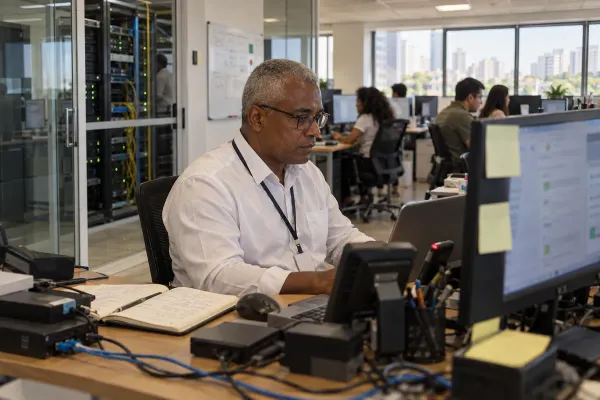
The problem
IT requests arrive by phone, by message, in the hallway, and end up in a notebook. Nobody knows how many there are, how long they take or which ones repeat. Without that number, you can neither say what is worth automating nor prove later that it improved.
In action
See it happen
- Ticket with owner and deadline
- Solution
- History
- Monthly volume
What it does
What your team stops doing
-
Gives owner and deadline
Every request becomes a ticket, with an owner, a deadline per category and a rule for when the deadline is missed.
-
Organizes
A service catalog and categories designed around what your IT actually handles.
-
Knows who is who
Directory sign-in and role-based profiles: who opens, who handles, who approves.
-
Measures
Volume and recurrence reports show what to automate first and prove that it improved.
In practice
In production at Grupo NTK
Service Desk runs today at Grupo NTK, alongside the other six solutions. What seven years of modernization changed is in the case.

What you get
What ends up running in your environment
- Service desk deployed on your server, with secure access
- Service catalog and categories designed around what your IT actually handles
- Sign-in through the company directory and role-based profiles: who opens, who handles, who approves
- Response deadlines per category, and what happens when they are missed
- Volume and recurrence reports, to see what to automate first
- Integration with iKSA: a request made in the chat becomes a recorded ticket
How it works
From request to record, step by step
-
We design the catalog
With categories for what your IT really handles.
-
We deploy it
On your server or in the cloud, with directory sign-in.
-
Requests come in
Through the service desk, from anyone with a profile to open tickets, or through the iKSA chat, which opens the recorded ticket on its own.
-
The number shows up
Volume, deadlines and what repeats, to decide what to automate and prove later that it improved.
Delivery models
Choose how to engage
On your server
Installed and configured in your environment, with your directory’s identity and the history kept in-house.
In your company’s cloud
A cloud server contracted in your company’s name, which we set up for you: faster start, no hardware to buy, with the same catalog and the same reports. The access and the data are yours; the cloud cost is your company’s, and we handle deployment and upkeep.
Every request becomes a number. That number is how you decide what to automate and prove it got better.